
The Faculty of Humanities and Social Sciences is a multi-disciplinary Faculty of the Nāgānanda International Institute for Buddhist Studies (NIIBS).

The Department of Applied Communication and Media Studies proudly launched the Nāgānanda International Journal of Applied Communication (NIJAC) as an academic platform dedicated to advancing scholarly research in the fields of applied communication, media studies, journalism, digital communication, and media technology. Published under the guidance of Senaka Senaviratne, the inaugural volume of NIJAC reflects the department’s commitment to strengthening research culture and academic excellence within Sri Lanka’s higher education sector.
NIJAC Volume I, Issue 01, published in April 2026 with ISSN 3051-486X, represents a significant milestone for the Department and for the broader academic community engaged in communication and media studies. The journal was reviewed by a distinguished panel of scholars from reputed Sri Lankan universities, including the University of Sri Jayewardenepura, University of Kelaniya, Open University of Sri Lanka, and the University of the Visual and Performing Arts.
The journal aims to create a dynamic scholarly forum for researchers, academics, media professionals, and students to discuss emerging issues in communication, media technology, digital culture, social integration, education, and contemporary media practices. The publication demonstrates the Department’s vision of integrating academic knowledge with industry-oriented communication and media education in Sri Lanka.
Brief Review of the Journal
The inaugural issue of NIJAC presents a valuable contribution to the field of applied communication and media studies in Sri Lanka. As one of the pioneering communication and media journals published within Sri Lanka’s private higher education sector, the journal successfully combines theoretical inquiry with practical and contemporary media concerns.
The articles included in this volume address diverse and timely themes such as screen media education, Buddhist communication perspectives, digital technology in education during the COVID-19 pandemic, reconciliation and national unity, online consumer behavior, radio listening practices, protest communication, and digital public relations strategies. These studies collectively reflect the interdisciplinary nature of communication studies and demonstrate the growing academic interest in media related social transformation in Sri Lanka and beyond.
One of the major strengths of NIJAC is its academic diversity. Contributions were received from scholars affiliated with leading national and international universities, including researchers from Sri Lanka and China. The journal also maintains academic credibility through a structured peer-review process carried out by experienced scholars and senior academics from reputed universities.
Furthermore, the editorial direction provided by Senaka Senaviratne emphasizes innovation, accessibility, and scholarly engagement. The electronic publication format enhances the journal’s international visibility and accessibility, enabling wider dissemination of Sri Lankan communication research to global academic audiences.
Overall, NIJAC can be identified as a promising academic journal that contributes meaningfully to the advancement of applied communication and media scholarship in Sri Lanka. It establishes a strong foundation for future research publications and serves as an important platform for emerging and established scholars in the discipline.
Vol. I Issue 01 (2024): Nāgānanda International Journal of Applied Communication
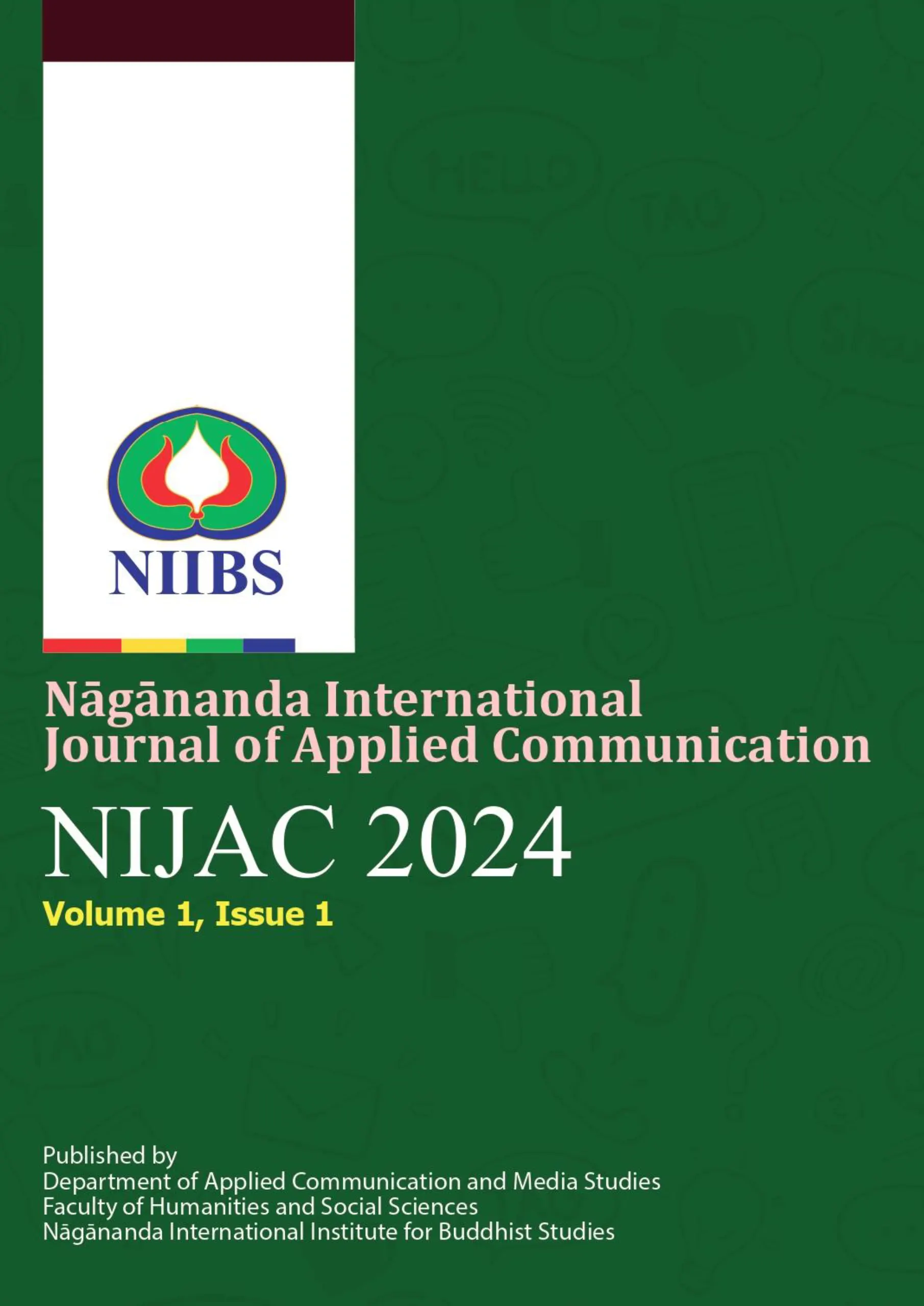
Nāgānanda International Journal of Applied Communication 2024 (NIJAC)
Issue DOI:
ISSN: 3051-486X
Published: April 2026